Creativity Isn't a Department
Co-authored by Nina Staer Nathan, Sunflower Communications & Nora DiNuzzo, Pitcher
Creativity isn't owned by the people with "creative" in their title. It's a way of solving problems, and it's the capacity every part of a mission-driven organization runs on. When a team decides in advance who is allowed to be creative, it cuts itself off from the problem-solving it most needs – and usually from the parts of the organization that can least afford the loss.
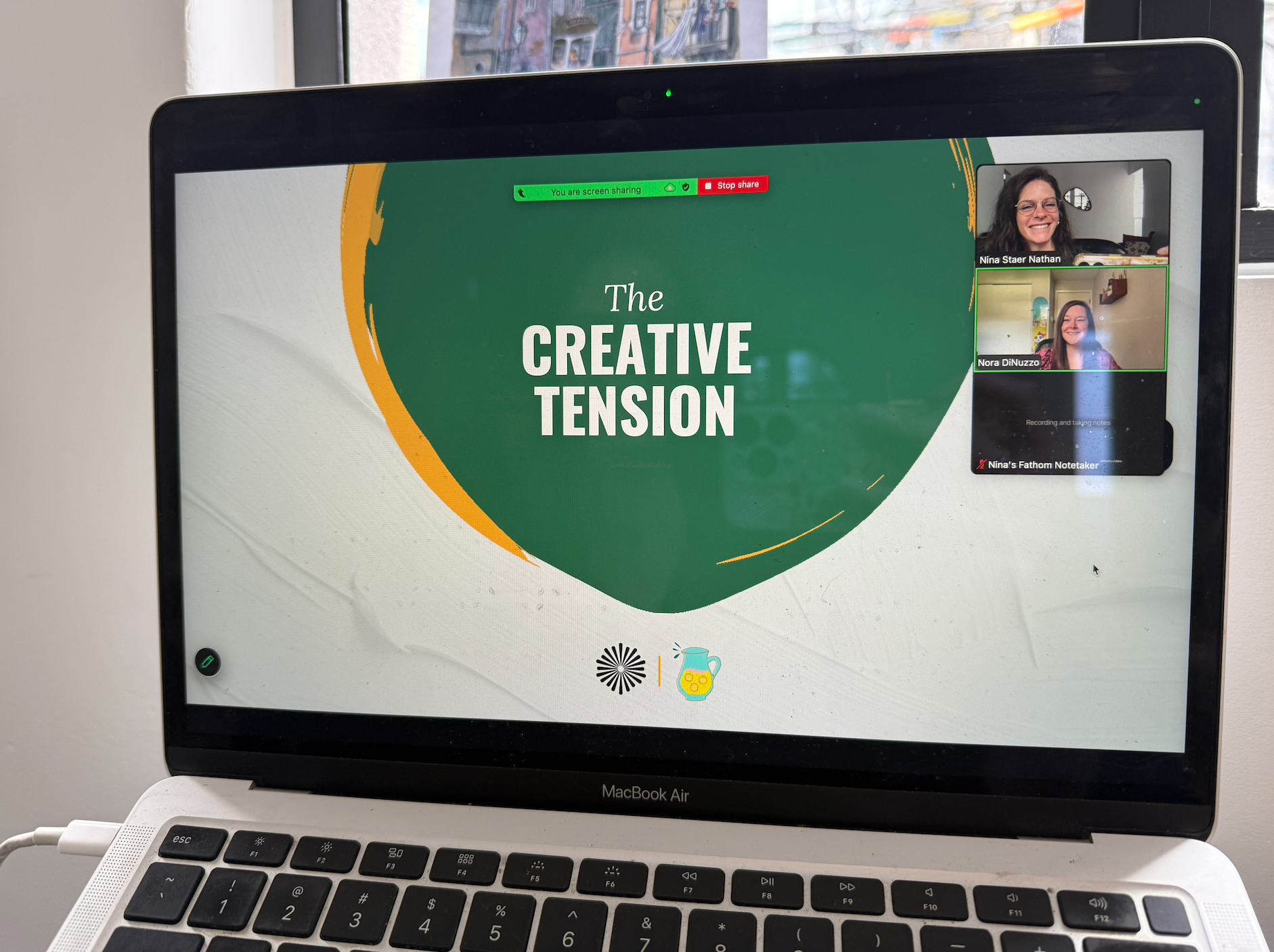
At our fourth roundtable in June, we put a statement on the screen and asked the room to react to it: I find it harder to call myself creative than to call myself professional. A good share of the people on the call agreed. Many of them run programs, write proposals, build partnerships, and solve problems that have no obvious answer. Still, the word "creative" felt like it belonged to someone else.
The roundtable, called The Creative Tension, was co-hosted by Sunflower Communications and Pitcher, and it drew people from across the impact sector and beyond. What surfaced over the hour was less about creative hobbies than about permission: who gets to claim creativity as part of their work, and who has been taught it isn't theirs to claim. That question matters more in impact organizations than almost anywhere else, because impact organizations run lean, and a capacity left unused on a lean team is a capacity the whole mission pays for.
Creativity gets filed under a job title
Nina (Sunflower Communications)
In the impact sector, creativity is usually treated as the communications function's job. The comms lead, the designer, the person who makes the deck look good. Everyone else is understood to be doing the serious operational work, and creativity is the thing that gets applied to it afterward, like a coat of paint.
That framing is a strategic mistake, and it's an expensive one for organizations that already have too few people. The hardest problems a mission-driven organization faces are not decoration problems.
How do you explain a theory of change to a program officer who has ninety seconds to grasp it? How do you hold a coalition together when two founding partners want different things? How do you rebuild a narrative after a funding source disappears? None of those are answered by making something look better. They are answered by creative problem-solving, the ability to see a situation from an angle no one has tried yet.
One participant put it plainly, that creativity is really the ability to solve problems, and that almost anyone can do it in their own way. When an organization has decided that creativity belongs to two people in the comms function, the problem-solving capacity of everyone else goes unclaimed.
The wider evidence says this is a capacity worth protecting. The World Economic Forum's Future of Jobs Report 2023 ranked creative thinking the second most in-demand skill among employers globally, ahead of resilience and leadership. It is not a specialist add-on. It is one of the core capacities the modern organization is built on – which makes assigning it to a single department a strange way to run a team that needs every person thinking.
The lane problem
Nora (Pitcher)
I spent the first fifteen years of my career in advertising agencies, where there is a literal creative department. That is where the awards go, and that is who everyone else defers to when the word "creative" comes up. For most of my career I worked in business development, on the revenue side. I was told – and then told myself – that I wasn't one of the creatives, because the structure I worked inside had already decided who was.
It took me a long time to see that business development is a highly creative practice. Persuading a client that you understand their problem better than any other agency in the country, finding the framing that makes someone say yes, writing the note that opens a new door – all of that is invention. I do it every day. I was told I was good at it. And I still hesitated to call it creative, because the org chart had trained me to think creativity lived one department over.
There's a reframe I return to often, from Elizabeth Leiba's book I'm Not Yelling: A Black Woman's Guide to Navigating the Workplace. She writes that she stopped saying she had imposter syndrome, when she started noticing that people around her were the ones treating her like an imposter. The feeling wasn't a personal flaw to fix. It was a response to structures that signaled, over and over, that certain contributions and certain people belonged, while others didn't.
Stay in your lane. That's not your role. This isn't the moment to share. When an organization sends those signals, people stop offering ideas – and the organization mistakes the silence for a lack of creativity rather than the suppression of it.
Research backs this up. A four-year study of creative workplaces found that only a third of support staff felt their organization gave them permission to take risks, compared with roughly two-thirds of executives. The people closest to the work felt the least entitled to bring their full thinking to it.
Creativity is how the logical thing actually reaches people
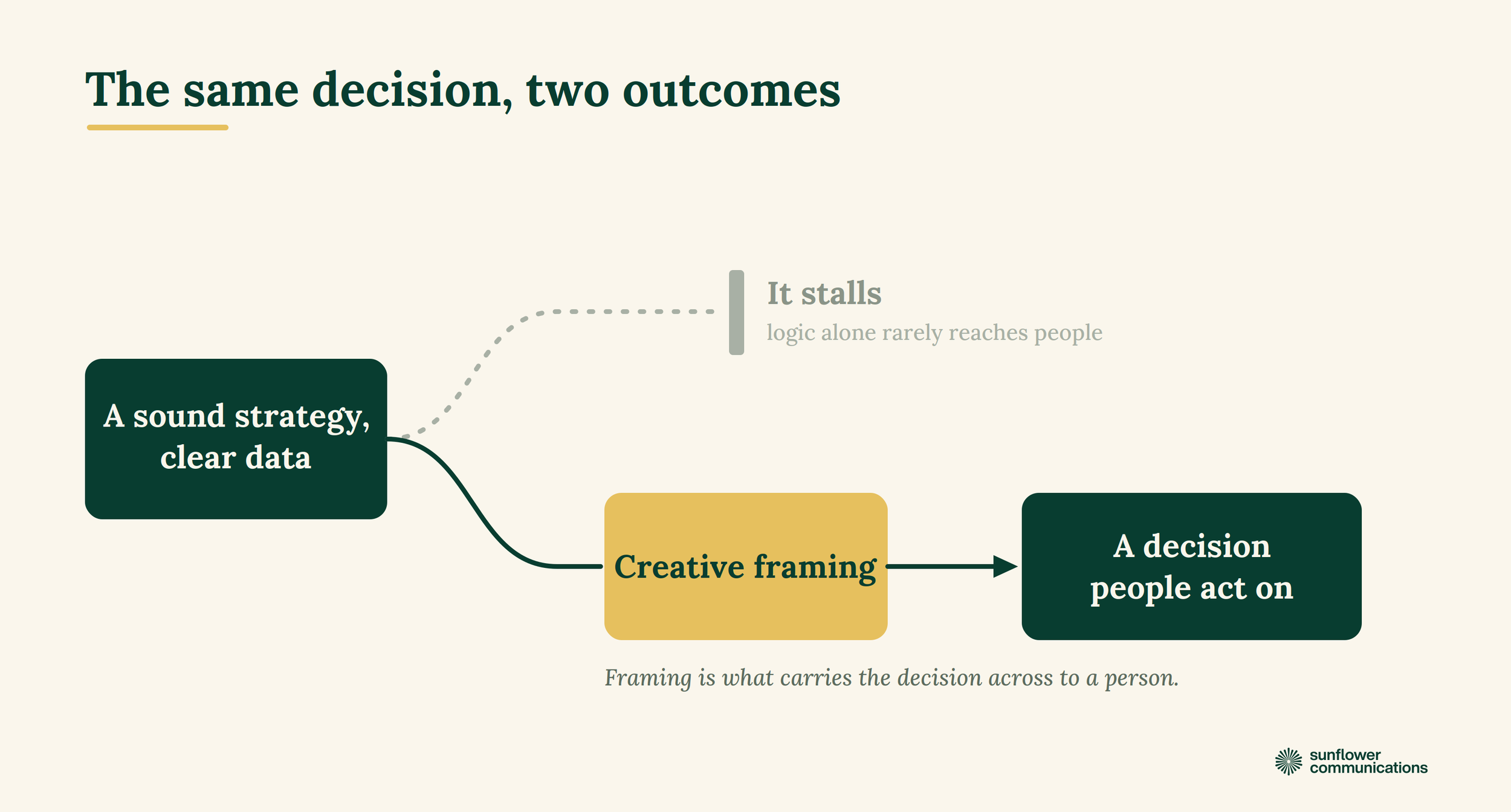
One exchange from the roundtable has stayed with both of us. A participant who works as a brand strategist made the case that a creative approach is how you get people to accept a logical decision. His example was a fitness brand whose message was that everyone is already strong, rather than the usual appeal to everyone's sense of failure. The logical action was the same either way – to exercise, to show up – but the creative framing gave people a way to say yes that the logical argument alone never could.
That is the part organizations miss when they treat creativity as decoration. The strategy can be sound, the data can be clear – and still the plan can still go nowhere if no one has found the way to make it reach a human being.
Creativity isn't the thing you add after the real work. It is the real work. It is often the difference between a good decision and a decision anyone acts on. For a foundation trying to move a field, or a nonprofit trying to change how a funder understands its work, that difference is the whole game.
What changes when creativity is treated as shared
Nina (Sunflower Communications)
The organizations we see get this right stop routing every creative decision through one or two people. The operations lead is invited to rethink how a process is explained, not just to follow it. The program manager who sits closest to the community is treated as a source of narrative, not a downstream recipient of it. The executive director stops being the sole author of the story and becomes one voice shaping it. Creativity gets distributed to where the work actually happens, which is also where the sharpest problems are best understood.
This is what we mean at Sunflower when we say communications is foundational rather than finishing. A team that treats creative problem-solving as everyone's job builds a kind of organizational capacity that a team relying on two "creatives" never will. Ideas surface earlier, from more places.
The narrative gets tested against more of the real work before it goes out. And the people doing the work feel ownership over how it's understood, which is its own form of retention in a sector that burns people out. The goal is to build that capacity across the team, not to concentrate it and then depend on the few who hold it. When creativity is understood as a shared capacity rather than a department, the organization has more of it to draw on, precisely when the work is hardest.
A shared reflection
What the roundtable surfaced, more than any single insight, was a room full of people doing inventive work who had been taught the word for it belonged to someone else. That is not a personal failing on their part. It is a signal about the structures they work inside. The good news? Structures can change.
Naming creativity as a capacity that lives everywhere in an organization, rather than a role assigned to a few, is itself the first intervention. It costs nothing and it changes who feels entitled to think. For the impact sector, where the problems are hard, the teams are small, and the stakes are real, that shift isn't a luxury. It's one of the more practical things a leader can do with the people they already have.
Stay connected
If your organization is thinking about how creativity, ideas, and problem-solving actually flow inside your team, and who has been left out of that flow, that's the internal communications and cultural infrastructure work we do at Sunflower. Book a call here or email Nina at nina@sunflower-communications.com
And if the growth side of your work has started to feel like a creative practice you'd like to get better at, that's Nora's world. Find her on LinkedIn or at pitchergrowth.com