Should Impact Organizations Use AI? The New Overhead Myth
A client came to us recently wanting a new website. The budget was the modest kind that doesn't stretch to a developer, and the expectation was the kind that usually requires one. We suggested they build the first version themselves with AI tools, which would have closed the gap between what they could afford and what they actually wanted. They hesitated, and not over ethics or quality. The tool felt big and unfamiliar, and learning it felt like one more thing on a list that was already too long.
That hesitation is everywhere in the impact sector right now, and it tends to get dressed up as something more principled than it is.
The applause for opting out
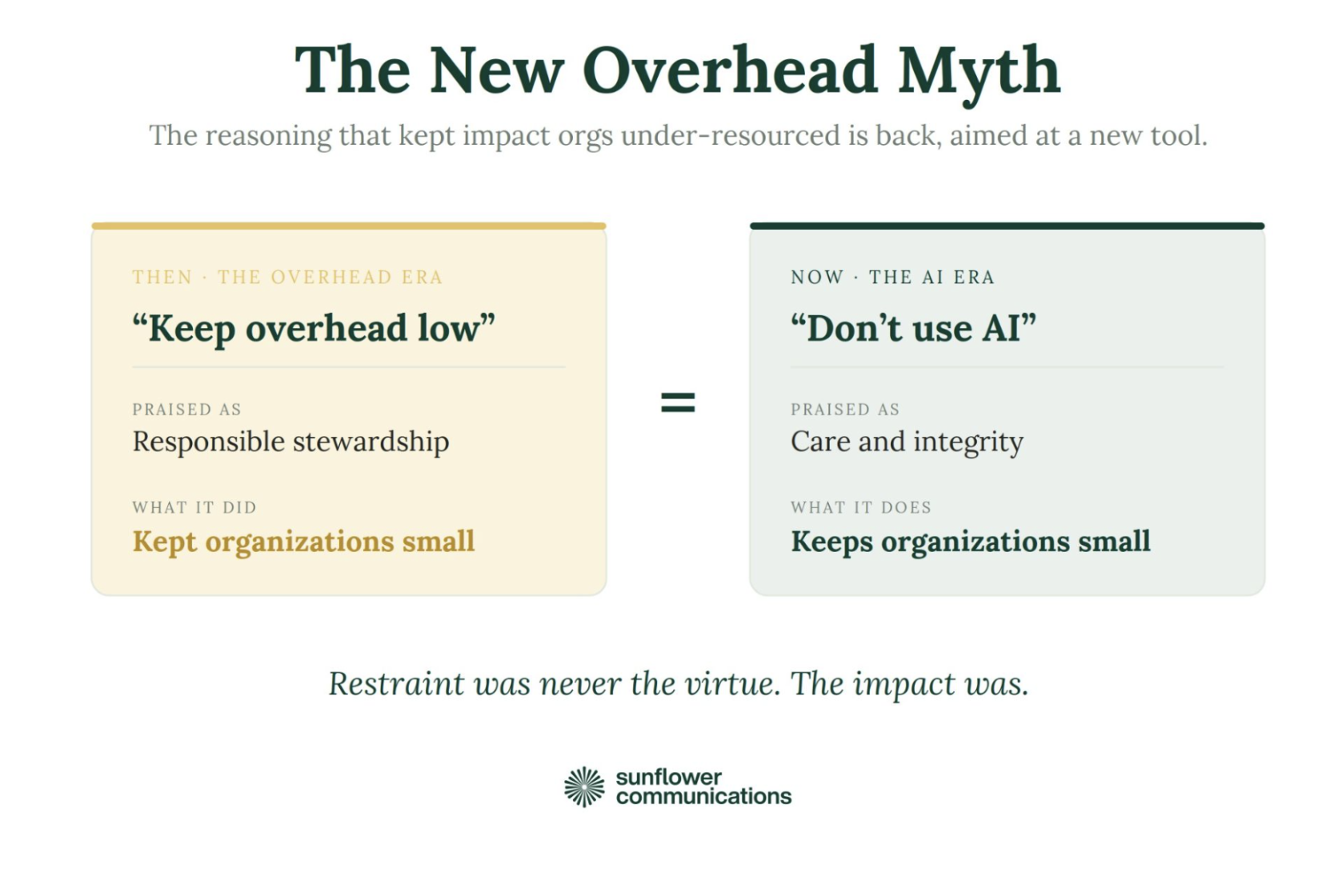
There is a particular kind of praise circulating in this sector at the moment, reserved for people who do everything by hand. Someone mentions they wrote a grant report or a campaign without AI and the response is admiration: that's real work, that shows care.
Using the tools, by the same logic, reads as cutting corners or compromising on values. The restraint becomes the credential.
Some of that instinct is earned. People in the impact sector are often the most thoughtful in any room about who built a technology, who profits from it, and who gets displaced by it, and the sector should keep asking those questions louder than anyone else. But that same care is the argument for using these tools, not for refusing them.
The people most alert to how a technology can cause harm are the ones who should be shaping how it gets used inside mission-driven work, and a sector that opts out on principle doesn't make the risk go away; it just leaves the shaping to people with no stake in the communities the work serves. Refusal feels like protection, but it is closer to a withdrawal, and the cost lands on the people the mission exists for.
We’ve been here before
The emergence of the internet raised the same alarm, and years later, the same thing happened with social media. Both reshaped how organizations communicate, raise money, and build movements, and in both cases the organizations that found responsible ways to use the new tools grew their reach while the cautious ones waited for a cleaner version that never fully arrived. The sector has a long habit of arriving about a decade late to the things that end up being non-negotiable.
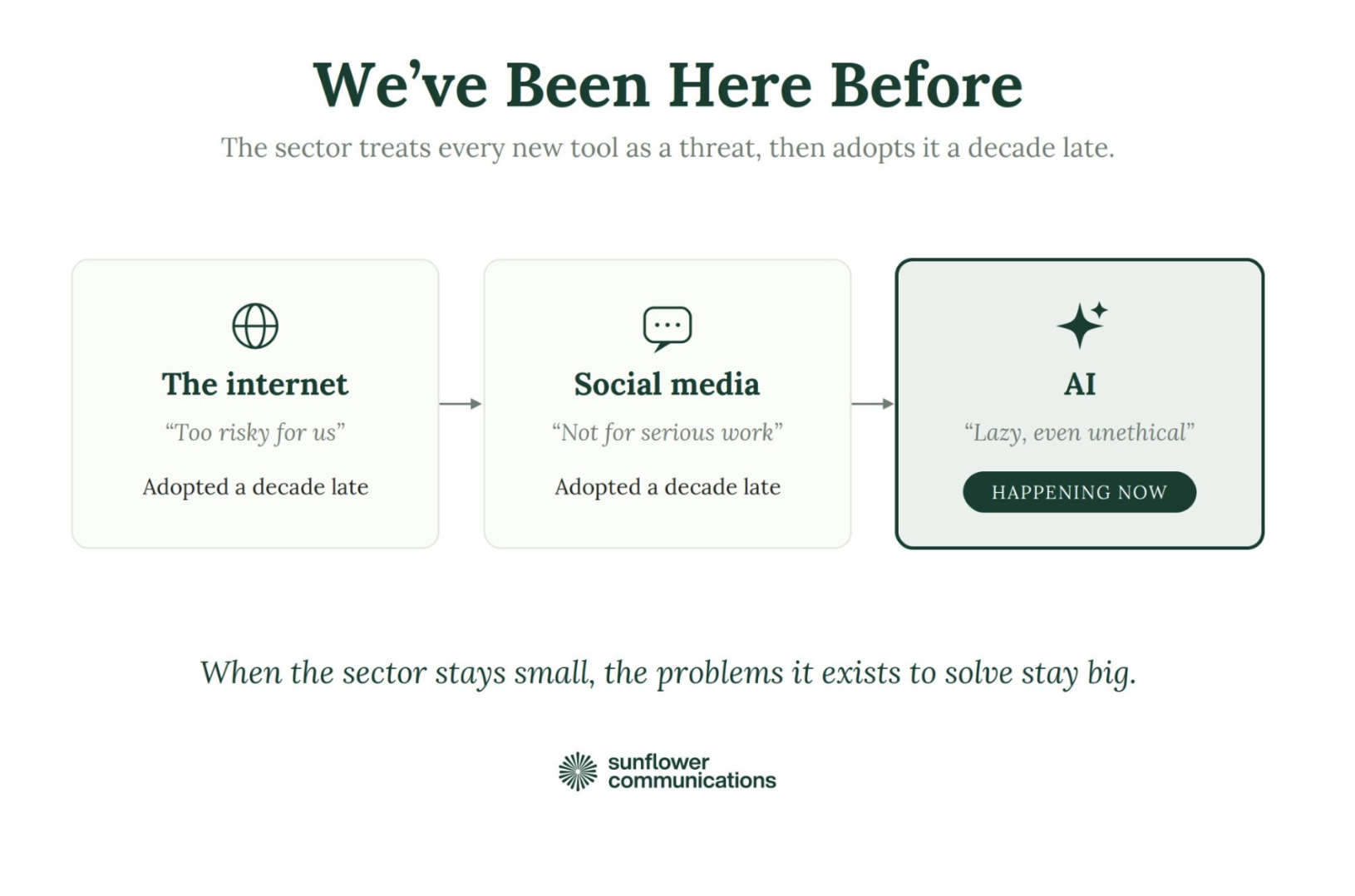
AI is following the same arc, except faster, and it is already past the point of being optional in most workplaces. A recent report from IBM and NationSwell found that 82% of nonprofits are now using some form of AI while 76% still have no policy governing it.
Together, those two numbers describe adoption without strategy, which is the worst of both options. And the hesitation is real: more than half of nonprofit practitioners report being afraid of AI. Fear is an understandable response to a fast-moving technology, but it's a poor basis for an organizational decision.
The most expensive virtue in the sector
There is a closer parallel than the internet, and it lives inside the sector's own history. The documentary Uncharitable, built on Dan Pallotta's work, makes the case that treating overhead as a moral failure has starved nonprofits of the capacity they need to grow. Keeping overhead under some arbitrary threshold gets celebrated as responsible stewardship, but in practice it often means almost nothing is being spent on talent, on infrastructure, on the marketing and communications that let an organization compete for attention and funding.
Pallotta's line is that no one wants their life's work remembered for keeping costs low; they want it remembered for changing something. charity: water is the example most people in the sector already know. Scott Harrison built it by thinking like a brand and a tech company rather than a traditional charity, investing in storytelling, design, and marketing at a level the sector considers excessive, and that investment is a large part of why it grew into one of the most recognized water organizations in the world. Restraint was never the virtue — the impact was, and the impact required spending on the things that make impact visible.
AI is the same question wearing new clothes. A tool now exists that can extend the capacity of an under-resourced team, and the sector's first instinct is to ask whether using it is “allowed”. The more useful question is how to use it well, on terms that match the organization's values, because the cost of refusing it is the same cost the sector has been paying on overhead for thirty years: smaller organizations, smaller reach, and slower progress on the problems the sector exists to solve.
What the gap actually costs
Back to the client and the website. The true math is that their expectation and their budget did not match, which is a situation almost every organization in the capacity window recognizes. AI does not resolve that tension by magic, but it does change the shape of it. If they push through the learning curve, which is a few uncomfortable weeks rather than a new hire, they get a functioning site without the cost of a developer they could not afford anyway. The money that would have gone to a contractor stays inside the organization, available for the staff, the systems, and the capacity the sector is usually pressured to starve.
Multiply that across an organization. The same report estimates that building AI fluency could produce efficiency gains worth the equivalent of a $100,000 unrestricted grant for a $1 million nonprofit. For the organizations we work with, running budgets between $1M and $20M, that is not a rounding error. That is staff time returned to relationships, to strategy, to the unglamorous infrastructure that lets an organization grow rather than only survive. Treating AI as a compromise to be avoided means leaving that money, and that time, on the table in the name of a virtue that was never serving the mission.
The ethical concerns are real, and an organization that adopts AI without thinking about data, consent, and the people its work touches is being careless rather than principled. Working through those questions carefully is part of doing this well, and it is exactly the kind of thinking the sector is good at. But there is a difference between adopting a tool with care and refusing it to stay clean, and only one of those is a strategy. When the sector stays small, the problems it exists to solve stay big. Staying small has never been a mission.
Stay connected
If your organization is weighing how AI fits into its communications without losing what makes the work yours, that is a conversation worth having before the tools get adopted by default.
Book a call here or email me at nina@sunflower-communications.com