Co-authored by Nina Staer Nathan, Sunflower Communications & Audrey Selian, Artha Impact / Rianta Capital ZurichLeadership is usually pictured as something that happens in front of other people, and yet for the person carrying responsibility for what happens next, it is often one of the most solitary things they do. Even surrounded by a capable team, a board, advisors, and a community that believes in the work, the weight of the uncertainty tends to fall to one person, because that person is the one who answers for it.
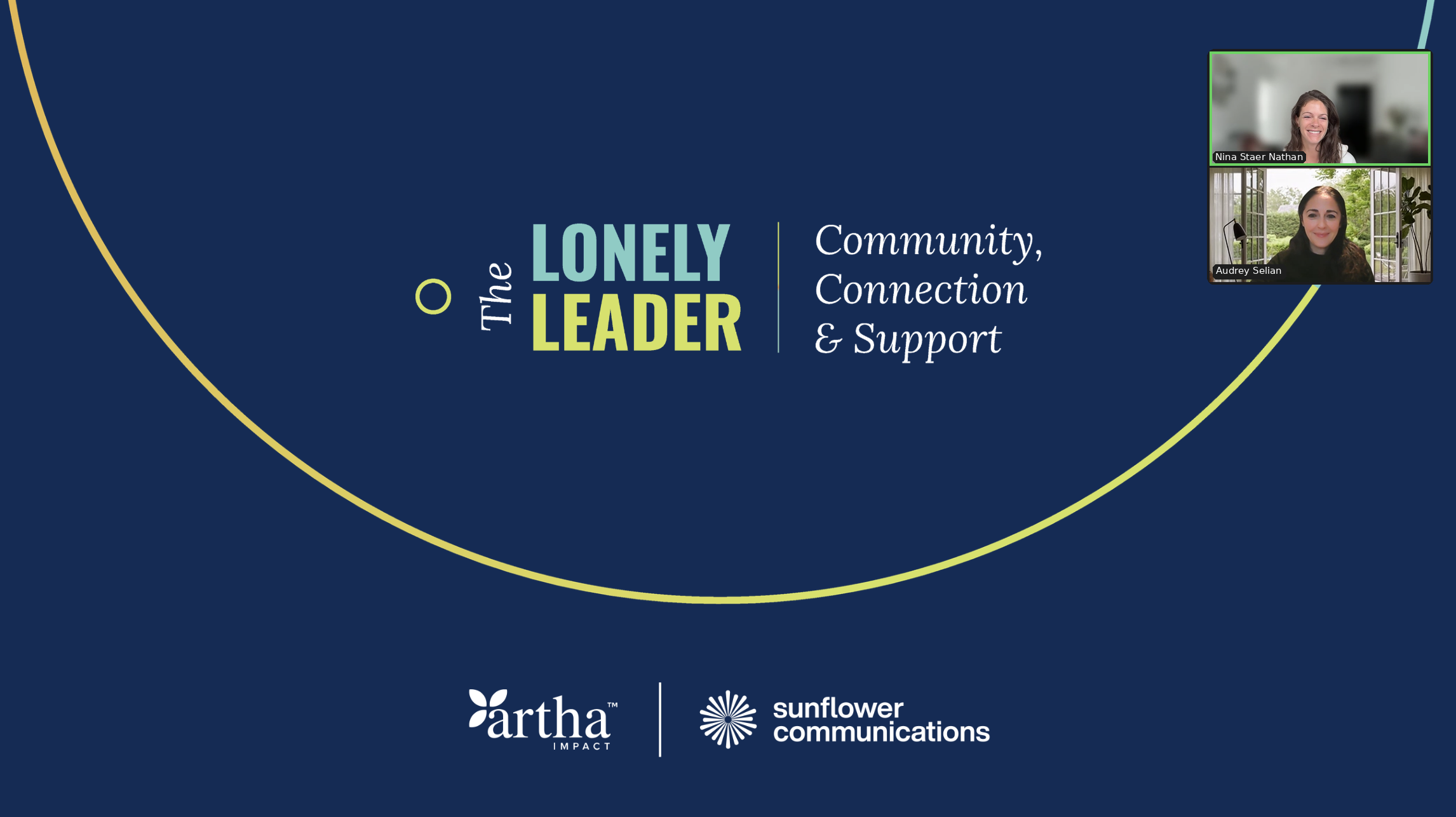
At The Lonely Leader, the fifth roundtable in our series, people joined from Mexico, Guatemala, Costa Rica, Colombia, across the United States and Canada, the Netherlands, France, South Africa, and Switzerland. These roundtables have always been about community, which is what made this particular topic feel so close to home. We co-hosted it together, one of us running a communications practice in the impact sector, the other investing in mission-driven founders for close to two decades, and from both vantage points we kept arriving at the same thing: the people doing this work rarely lack commitment or talent, and often lack somewhere to put the harder parts down.
The gap between having people and having room
Nina (Sunflower Communications)
We opened with a poll, asking how strong people’s networks are, the people they can turn to for advice or perspective. Most answers sat at an eight or nine out of ten, which was heartening. Then we asked a second question: how often do you have the room to be open about the harder parts of your work? The most common answer dropped to three.
That gap between the two numbers is where the real conversation was. People have built community around themselves and still have very little space inside it to say that a decision is heavy, or that they don’t yet know the answer. A few participants traced it to the shape of their teams. One works mostly with contractors and described how there isn’t anyone to voice the day-to-day to, so you carry it on your own. Another, now a solo founder after years of running a company with a partner, said her fix was to curate a circle of other founders, people in the trenches who understand the building even when the details of your business aren’t theirs.
One participant got at what’s underneath it:
“The nature of the role is to carry these things by yourself. When you ask your staff to carry your burdens, you’re enrolling them in a way that doesn’t serve their goals. It’s part of the role. It’s part of the design.”
— Roundtable participant
That reframed the conversation for a lot of us. The isolation isn’t a personal failure of networking, it’s built into the position.
The weight you can’t hand off
Nina (Sunflower Communications)
Starting something means believing in it before anyone else does, and that early conviction is a weight most leaders carry on their own. When early-stage entrepreneurs I mentor ask what makes someone last, I tell them it’s unwavering motivation, the thing that gets you up on a bad day to do the work again, and then again the day after that. The harder truth is that the same motivation turns into responsibility the moment a team and clients are depending on you.
Part of what makes it lonely is that you’re expected to look certain while you’re still working it out. In the first couple of years of Sunflower, I made a lot of it up. A client would ask whether we’d thought of something, I’d say we were already on it, and then I’d go and build the thing before the next call. That is how we grew, and it is also how I learned that projecting confidence has a cost: it leaves you with the sense that you can figure anything out, until the day the decisions pile up and you can’t make one more. I’ve come close to burning out that way more than once.
There’s a second cost that comes up again and again, which is how often this work gets discounted by the people closest to us. One participant said it had taken years for her parents to stop calling it her “little business.” Another described a relative getting a doctorate, met with real investment and pride, while her own work took the same years and money and was never seen the same way. “It’s not a hobby,” she said. I know the feeling. People have asked me what I’m doing sitting at my computer all day, and the honest answer is that I’m thinking, which happens to be a large part of the job.
What the outside eye can see
Audrey (Artha Impact / Rianta Capital Zurich)
My work for the better part of twenty years has been to play a supportive role as an investor driven by impact, bringing an engaged stakeholder perspective to founders building businesses for underserved communities, mostly in India. What I notice, over and over, is that the leaders who do best are usually the ones able to confer trust on the people around them. The challenge lies, of course, in ensuring they have surrounded themselves with the right skills and personalities. The hardest journeys I’ve watched from a board seat were the ones where a founder couldn’t get past territoriality, where growth brought in new people who didn’t share the original mission, and where the absence of trust showed up later as problems with governance, cash, and basic operational discipline.
This matters more in mission-driven work than almost anywhere else, because the sense of self is so bound up in the work. Social entrepreneur founders aren’t running a business on the side of their lives, they’re living out a calling, and when the calling and the identity are the same thing, letting other people in feels riskier than it is. I’ve seen teams survive extraordinary shocks, including an entire portfolio brought to its knees when India pulled its small bills out of the economy overnight during ‘demonetization’, and the ones who came through were almost always the ones who had already learned to share the weight rather than guard it.
An outside eye also sees what a team has stopped noticing. When you’re deep inside an organization, the assumptions you treat as fixed become invisible to you, and a question from the outside, asked with some humility, can surface the thing everyone has normalized.
Lasting, not simply bigger
Audrey (Artha Impact / Rianta Capital Zurich)
The reflex in impact work is always to go wider: more villages, more households, more units of whatever good you’re distributing. Sometimes that’s right. Sometimes the more useful move is to go deeper, to stand still long enough to ask what strengths a team has already built and what is working well enough to double down on. That’s the appreciative inquiry lens, the opposite of the usual due-diligence instinct to find everything that’s broken. Some of our companies have served last-mile communities for over a decade, and simply still being there is an achievement worth protecting before you pile the next sixteen challenges at a team’s feet.
Nina (Sunflower Communications)
This is where Audrey’s point met something I say constantly to the people I mentor. One entrepreneur came to me recently with a list of everything she’d accomplished, asking what was next. My answer was that maybe nothing new is next, that the work might be to keep doing the few things already working and go deeper into the relationships she’d started to build. We’re wired for shiny-object syndrome, always reaching for the next idea, and some of the most useful advice I can give from my own experience is that when something is working, the discipline is to keep doing it and see what grows rather than add another thing.
A shared reflection
Part of why this is worth taking seriously is that connection isn’t a soft benefit. The U.S. Surgeon General’s 2023 advisory on loneliness reported that people with stronger social relationships have a substantially lower risk of premature mortality, which is a striking way to think about something we tend to file under nice-to-have. For leaders, the practical version of that research is building a structure for support before the crisis, not during it. One participant, who works on the funder side, put it well: entrepreneurs don’t get a board to report to the way a nonprofit does, so you have to build your own, “a kitchen cabinet of friends, colleagues, and mentors who almost informally serve as a board. They have to be very honest and very frequent.”
The irony, as Audrey noted during the session, is that founders tend to reach for this kind of support only once they’re deep in the weeds, when making the time earlier might have kept them from getting so far in. The leaders who do this well don’t wait. They build the relationships while things are steady, treat asking for help as a sign of dexterity in leadership rather than weakness, and make room for the parts of the work that don’t have clean answers.
What came through most, across ninety minutes and a dozen countries, was how much lighter the work gets the moment someone says the hard thing out loud and hears, from someone who has been there, that they’re not carrying it alone.
Stay connected
We’d love to keep this conversation going.
→ If your organization is working through questions of internal communication, team culture, or the cultural infrastructure that helps people carry the work together, connect with me here, and stay tuned for future roundtables. Our next one is in March, and you can sign up through our newsletter to hear when registration opens.
→ For the view from the investment and ecosystem side of mission-driven work, find Audrey on LinkedIn.