How Comms & Leadership Are More Connected Than You Think
A founder I mentor came to a session wanting to solve a positioning problem. She was building a venture and still deciding what it was, whether a product, a service, or something between the two, and she wanted to know how to talk about it so people would understand it and buy. Those are reasonable questions, and all of them sit downstream. So I asked her the one that sits upstream, which is who she was speaking to and why. She didn't have the answer yet, and that was the real finding of the session. What looked like a communications problem was a foundation that hadn't been decided.
Why the question underneath keeps getting skipped
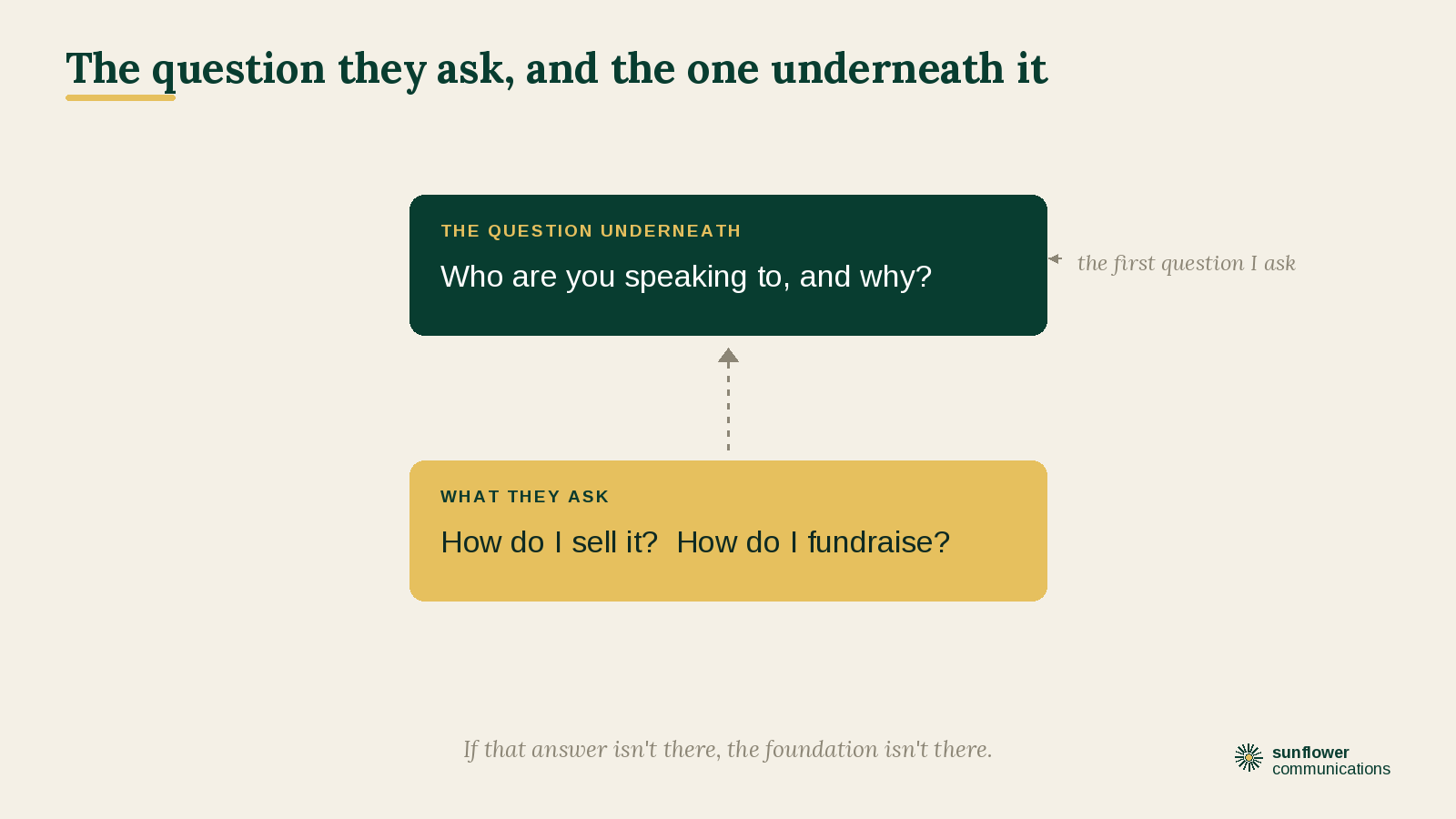
This is where most conversations with a founder or an executive director end up, whatever they were about at the start. Someone arrives with a question about output, how to run the campaign, what to post, how to raise the money, and the honest answer is another question about who they are and who they are for. When that answer isn't there, no campaign supplies it, because the missing piece was never the campaign.
This gets skipped because of what people assume communications is. A social post looks like a task, the kind of thing you hand to an intern, something quick that should cost very little, the same instinct that treats communications as overhead to keep low. What sits behind the post is a different order of decision: who the organization is, what it stands for, how it wants to be understood, what it will say and what it refuses to say. Nobody would hand the definition of their own identity, as a person or across a career, to an intern and consider it settled, yet organizations do exactly that with their communications, because the post is visible and the identity underneath it is not.
What a communications strategy is
When I say communications strategy, I mean the set of decisions that sit under everything an organization ever says: who you are, what your goals are, who your audience is, the language you use and the language you refuse, how you will reach the people you are trying to reach, and what you want them to feel when they find you. That is an identity, and an identity is decided by whoever carries responsibility for the direction of the organization, which makes it a leadership decision and not something to pass down to the person managing the channels.
I watched this happen on that mentorship call. Every question the founder brought me about how to communicate her venture routed back to the same place, which was who she was building it for. Late in the call she asked what mistake I see people make most often, and it is this one: they go straight to being on social media, straight to posting, with no base underneath and no shared answer to who they are or who they are speaking to. Everything that comes out after that reads as jumbled, because there is no clear identity holding it together, and the audience lands on it with no idea what the organization is or what they are meant to do next.
Why skipping it costs more now
A few years ago an organization could get away with skipping the decision, because good-looking materials did enough on their own to signal that someone serious stood behind them. That has changed, because polished output is cheap now, close to free, and a professional-looking version of an unclear message is available to anyone in an afternoon. What that leaves as the thing separating one organization from another is the decision underneath, whether there is a clear and shared answer to who you are and who you are for. That decision is the one part of this that cannot be produced on demand or handed to someone junior, which is what makes it the foundational work rather than the finishing work. It is also the part most likely to go undecided, because it is the hardest to see from inside, which is why an outside read matters, and the easiest to defer.
The part that can't be delegated
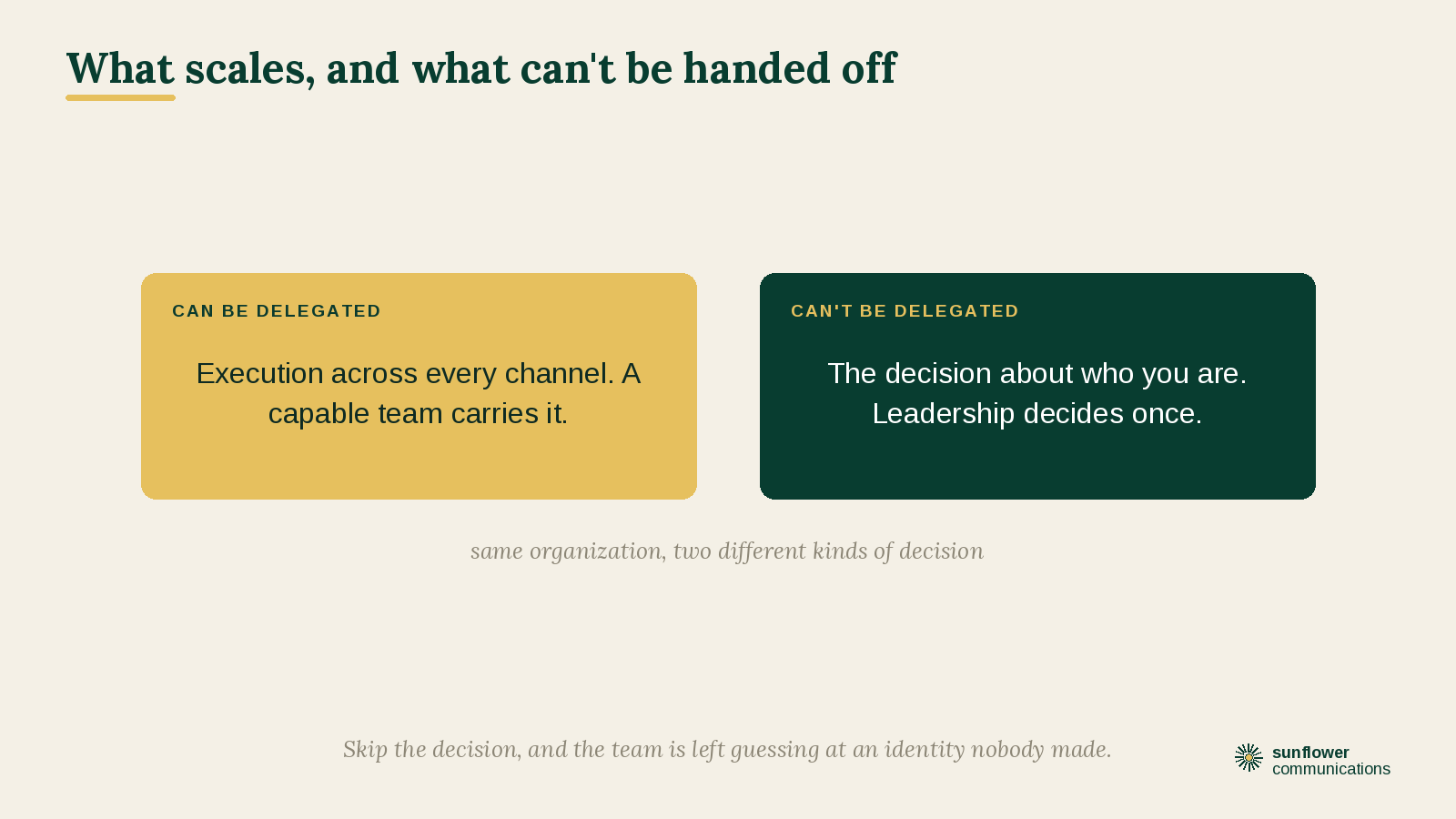
None of this means leadership has to run the communications. The execution scales, and it should. A capable team can carry a message across every channel, and part of what we do inside a retainer is coach the communications managers and team leads who run that work day to day, so the organization builds its own capacity instead of depending on us. What does not scale, and cannot be handed off, is the decision about who the organization is. Leadership makes that call once, and then everyone downstream has something true to build against. Skip it, and the team is left guessing at an identity nobody decided, which is how an organization ends up with a website, a newsletter, and a social feed that each sound like a different place.
The founder I mentor left that session without a finished brand and with something more useful, which was the recognition that she had been asking a communications question when the work in front of her was a decision about who she was building for. That is the conversation I keep ending up in, whether someone comes to me for communications or for leadership, because underneath they are the same conversation. An organization cannot tell the world who it is until its leaders have decided it, and deciding it is the work that belongs to them.
Stay connected
When communications gets handed off before anyone has decided the foundation underneath it, the work looks busy and goes nowhere, and the place to start is knowing where that foundation stands. Take the Impact Comms Diagnostic here to get that read in twelve questions.
Also stay tuned for our next roundtable, The Lonely Leader, coming up this October. It takes on the part of this most leaders carry alone, being the one who has to decide who the organization is. Get on our email list to receive the invite.