The Work Behind the Work: Invisible Labor, Communication Design, and What Healthier Workplaces Could Look Like
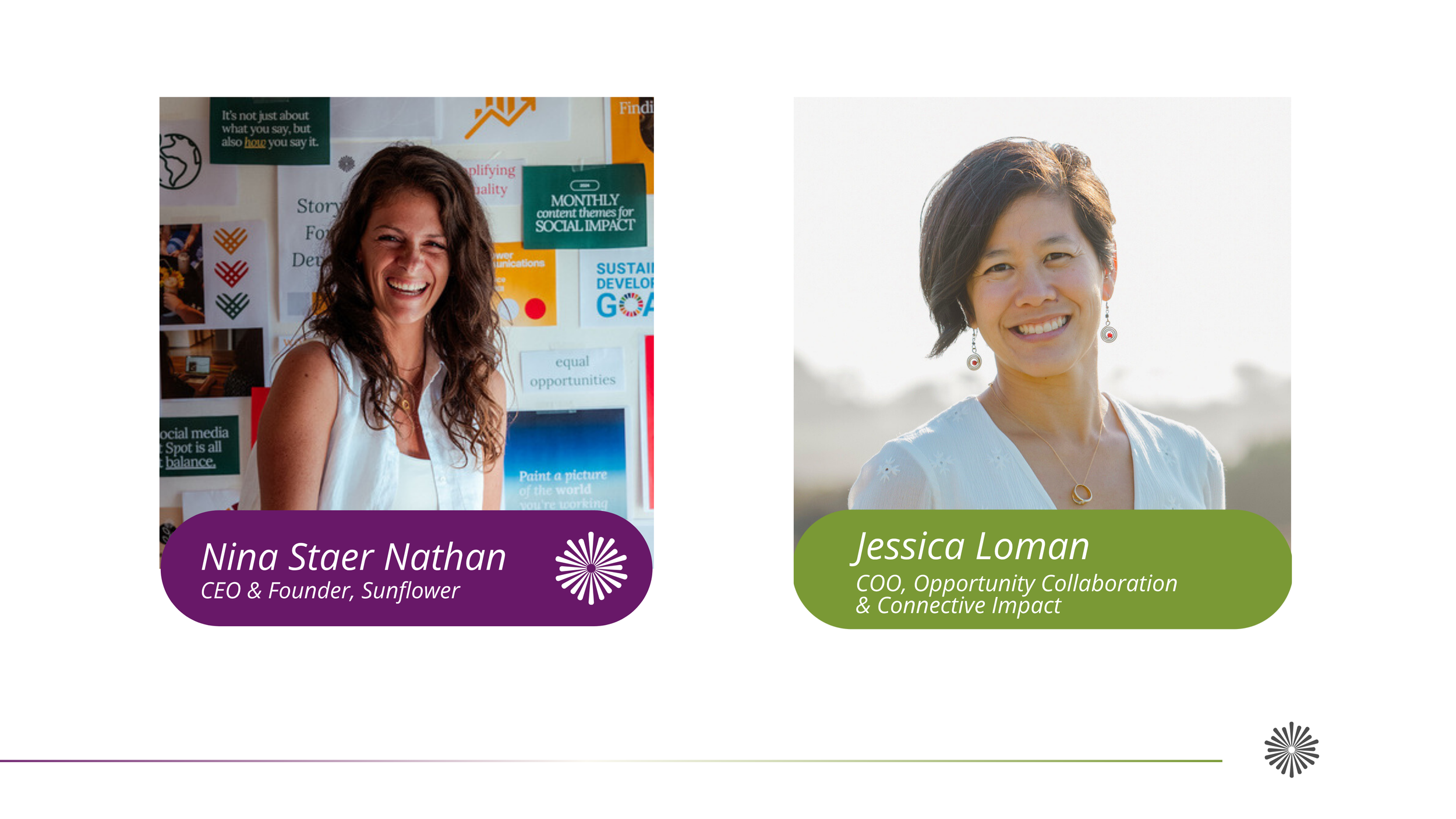
Co-authored by Nina Staer Nathan, Sunflower Communications AND Jessica Loman, Opportunity Collaboration & Connective Impact
There is a particular kind of exhaustion that many of us in the social impact sector know well.
It is not just the weight of the mission. It is the weight of everything that happens around it. The coordination emails that go unanswered. The person who held all the institutional knowledge in their head and left. The unwritten rules everyone is expected to know but no one ever wrote down. And the quieter tensions beneath the surface: decisions made without those closest to the work, voices that go unheard, and the invisible dynamics that shape who holds power and who doesn’t.
There’s all that goes into managing a healthy team and supporting their livelihoods, and then there’s caring for a team in times like these – a team and community of changemakers who care deeply for the world and often carry more than their share of its weight.
This March, for Women's History Month, we co-hosted a roundtable with leaders across the social impact space. We wanted to hold space to reflect honestly on the less visible parts of how we work — not just what we accomplish, but what it actually takes to hold it all together.
The conversation was honest, layered, and for many of us, deeply familiar.
We are coming at this from different angles — one of us in communications strategy, one in ecosystem building — but we have seen the same thing from both sides: the systems we work within shape not just what gets done, but who carries the weight of getting it done.
Naming what often goes unnamed: Invisible Labor
Nina (Sunflower Communications)
When we were planning this roundtable, we kept coming back to the phrase "invisible labor."
In impact organizations especially, this kind of labor tends to be concentrated. Teams are lean, budgets are stretched, and the culture of doing more with less can often set an expectation that certain people — often women, often those with less positional power — will absorb the gaps.
What makes it tricky is that this work does not always feel like a burden to the people doing it. Many of us genuinely love our teams and our missions. But commitment and compensation are not the same thing. And the absence of systems to support and distribute this labor has real consequences over time.
One participant said it in a way that stuck with me:
“In a previous role, I loved the mission and was incredibly passionate about our work. But the culture was always toxic and roles were rarely defined — while expectations were high. If the culture could have improved, even slightly, I would not have left when I did.
”
That landed for a lot of people in the room. Loving the mission and having a sustainable place to do it should not be mutually exclusive. But a lot of us have had to choose.
Jessica (Opportunity Collaboration / Connective Impact)
What strikes me most is how structural this is.
We tend to talk about invisible labor as a personal problem — a capacity issue, or a team dynamic that needs managing. But in most cases, it is a symptom of systems that were not designed with the full complexity of human work in mind.
At Opportunity Collaboration and Connective Impact, we’re intentionally practicing what healthier workplaces, communities, and ecosystems can look like when we prioritize relationships before transactions, share power, and embrace that we are pieces of the same puzzle. It’s ongoing work, and requires continual attention and intention. What surfaced in the roundtable reflects how far many of us still have to go.
In our roundtable poll, the two most prevalent patterns that participants have noticed are:
Decisions made by a small group with little transparency
People feel unsafe challenging leadership
This was further emphasized by a participant’s share of their experience:
“It’s actually the hardest to leave when you love the work itself, but the leadership makes it impossible to do it in a healthy way. I knew it was time to leave when every time I tried to give constructive feedback, I got shut down and
dismissed.”
The mismatch between how organizations are designed and how humans function within them does not resolve itself. And it does not distribute itself evenly.
“How do we create the space for people to take care of each other — without management telling me to do it?”
That question stayed with us for the rest of the session. It is not rhetorical. It deserves a real answer.
Communication design as cultural infrastructure
Nina (Sunflower Communications)
One of the questions we posed to the group was: where do unclear expectations and undocumented processes create invisible labor inside teams?
The answers were different, but they kept pointing to the same root — a communication gap that had never been formally addressed.
When I talk about communication design, I am not talking about brand voice or external messaging. I mean the internal architecture of how information flows, how decisions get documented, how people know what is expected of them.
That architecture either supports people's ability to work with clarity and confidence — or it creates extra labor for whoever ends up filling the gaps.
At Sunflower, we call this cultural infrastructure. The systems and norms that shape how a team operates day to day: who carries what, how conflict gets surfaced, whether people feel safe enough to name a problem before it becomes a crisis.
When those systems are intentional, teams operate with more trust and shared understanding. When they are not, the work of keeping things together falls to whoever is most willing — or most expected — to hold it.
Jessica (Opportunity Collaboration / Connective Impact)
Communication gaps are rarely just logistical. They are cultural.
When decisions live only in someone's head, that is a power dynamic. When processes are never written down, access to institutional knowledge becomes informal and unequal. When the expectation is that people will "just figure it out," it usually means some people carry that quietly — and others never notice it happening.
“Knowing what people are empowered to do versus needing to route things through multiple layers of approval helps lighten the load across the board. And makes it less transactional.”
Communication and relationship building design, done well, are equity interventions. It is not the flashiest work. But it is some of the most consequential work an organization can do.
What healthier workplaces could look like
Jessica (Opportunity Collaboration / Connective Impact)
We asked the group to imagine: what would workplaces look like if systems actually accounted for human and cyclical needs?
I love this question because it does not start from what is broken. It starts from what is possible.
For me, healthier workplaces are ones where relational work is treated as real work. Where the time spent building trust, navigating conflict, or supporting a colleague through a hard stretch is not something people do on top of their jobs — it is recognized as part of the job.
That requires a real shift in how we measure contribution and value, especially in organizations that say they care about people.
It also requires being intentional about power. Healthier workplaces are ones where leadership does not create bottlenecks and dependencies. Where decisions are made transparently and ownership is actually shared.
“Sharing power gives me ownership to be creative and solve problems quickly. It requires trust — when that’s given, even unspoken, it’s very freeing. We’re exploring co-leads and flat org charts to move away from hierarchies.”
Nina (Sunflower Communications)
I keep thinking about what it means for teams to feel genuinely supported — not in a perks-and-wellness-initiatives way, but structurally.
What does it look like when someone can raise a concern and actually trust that it will be received? When onboarding prepares someone for the informal norms of a team, not just the formal ones? When no single person has to hold all the context?
The organizations I have seen make real progress on this share a few things. They treat internal communication as a strategic function, not an afterthought. They document not just what decisions were made, but how and why. They create space for feedback — including feedback about the systems themselves.
“We’re asking the culture team to add their work to their performance objectives so the effort is documented.”
That is what it looks like to take invisible labor seriously. To name it, track it, and actually account for it.
None of this is easy, especially in under-resourced environments. But the cost of not doing it — in burnout, turnover, and eroded trust — is far higher than most organizations account for.
A shared reflection
When we look at the numbers — fewer than three in ten leadership roles held by women globally, just one in fifteen CEOs (International Labour Organization) — they are not just statistics about representation.
They are a window into the structures that have determined whose contributions are seen, rewarded, and built upon.
In the social impact sector, where the work is often deeply relational, emotionally demanding, and chronically under-resourced, those structures deserve honest scrutiny.
Women's History Month is a useful moment to acknowledge the work that has been done — including the work that was never formally recognized. But it is also an invitation to ask harder questions about the systems we are still working within, and what it would actually take to change them.
The answer is not a single initiative or a communication audit. It is a commitment to treating how we work together as seriously as what we are working toward.
“The infrastructure of a team is not separate from the mission. It is the mission’s daily reality.”
Stay connected
We would love to continue this conversation.
-> If your organization is navigating questions about internal communication, labor distribution, or cultural infrastructure, connect with me below and stay tuned here for future roundtable discussions.
Nina Staer Nathan — Founder and CEO, Sunflower Communications
-> Ready to practice our shared values towards healthier communities? Join us in-person for Opportunity Collaboration’s global unconference (OC2026) November 2-6, 2026 in Albufeira, Portugal. Learn more & register.
Looking for ongoing support with the invisible and visible labor of fundraising? Explore Connective Impact membership.
If you want to chat about either of the opportunities above, let’s connect:
Jessica Loman— COO, Opportunity Collaboration and Connective Impact