The Tactical Trap: Why Communications Asks Are Getting Smaller While the Real Gap Is Getting Bigger
I sent a proposal recently to an organization that had come to me asking for a website redesign. We got on a discovery call, and about twenty minutes in I realized the website wasn't really the problem. The Executive Director described the work one way, the program lead described it another, and the communications manager had a third version. Three smart people, one mission, three different stories.
I sent back a different proposal that put narrative and positioning first and the website second. The same dynamic is showing up across most of the proposals coming through Sunflower right now.
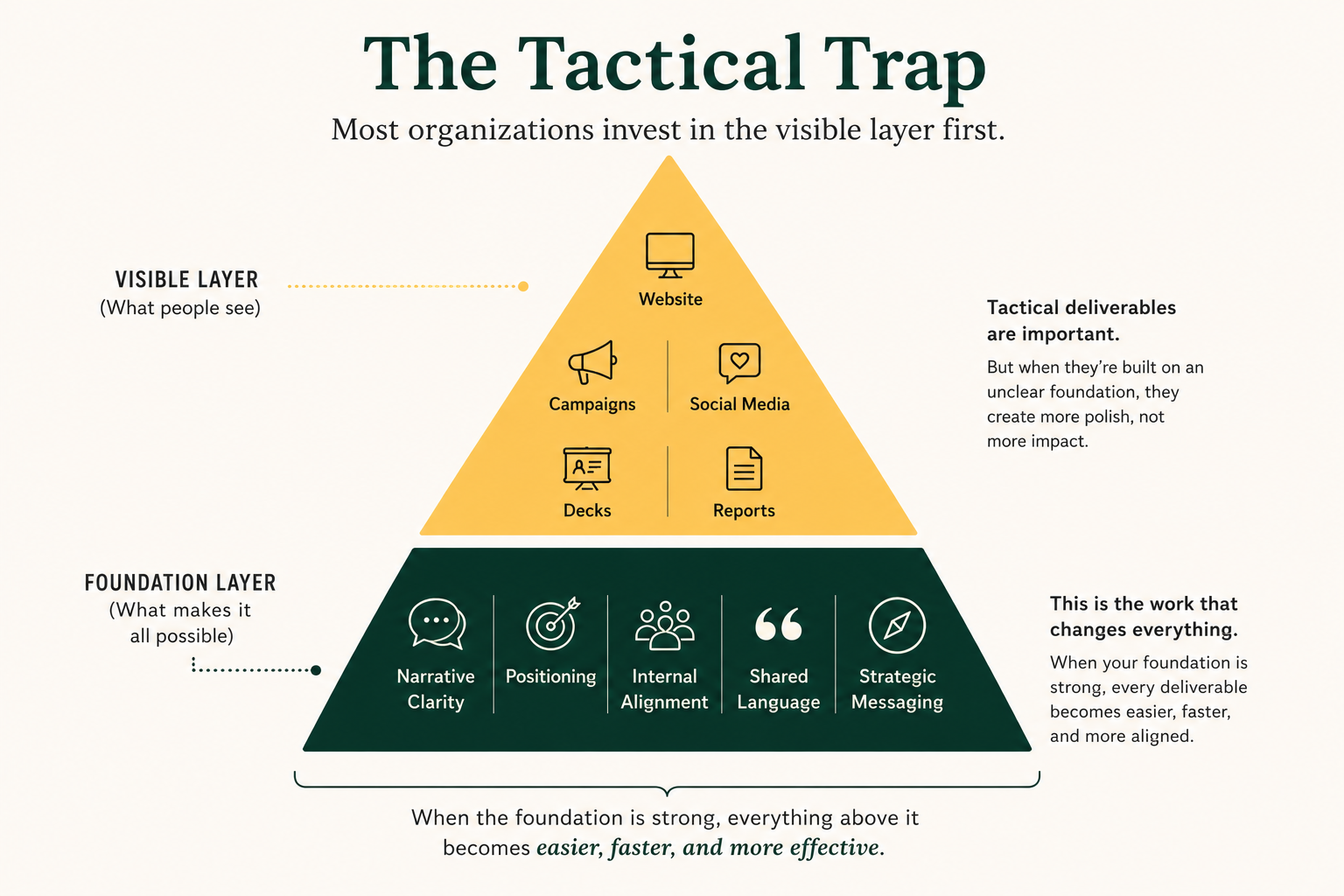
Organizations come to us asking for a tactical deliverable, a website, a campaign, a social media strategy, a refreshed deck, when the real gap is upstream. They do not have a clear, shared narrative yet, and no amount of polished execution is going to compensate for that.
What is making this harder to spot is that the tactical asks are getting more sophisticated, not less. Teams are coming in with thoughtful briefs, clear timelines, and a sense of what good execution looks like. The problem is that the brief is solving for the wrong layer.
Why this is happening now
A few years ago, an impact organization without a clear narrative could still get pretty far on the strength of polished tactical output. A nicely designed website, a consistent social presence, and a well-produced impact report were enough to signal credibility, and the unevenness underneath could stay hidden for a long time.
That gap has closed.
AI has made polished, generic copy nearly free to produce. Every organization can now generate a respectable website draft, a clean LinkedIn post, a passable funder one-pager, which means the differentiator has moved upstream. When everyone's outputs look acceptable, the organizations that stand out are the ones whose people, internally, can describe the work the same way without having to coordinate first.
At the same time, audiences are getting better at spotting when something is hollow. Funders, peers, program participants, and the wider sector are all running the same subconscious pattern-match that readers run on AI-generated text. Polished tactical output sitting on top of an unclear narrative reads as performance, and it reads that way faster than it used to. The aesthetics of credibility are no longer enough to carry an organization that has not done the work underneath.
So the pressure to produce tactical output is rising because everyone else is producing more of it, and the cost of producing it on a shaky foundation is rising at the same time because audiences see through it more quickly.
What narrative clarity actually is
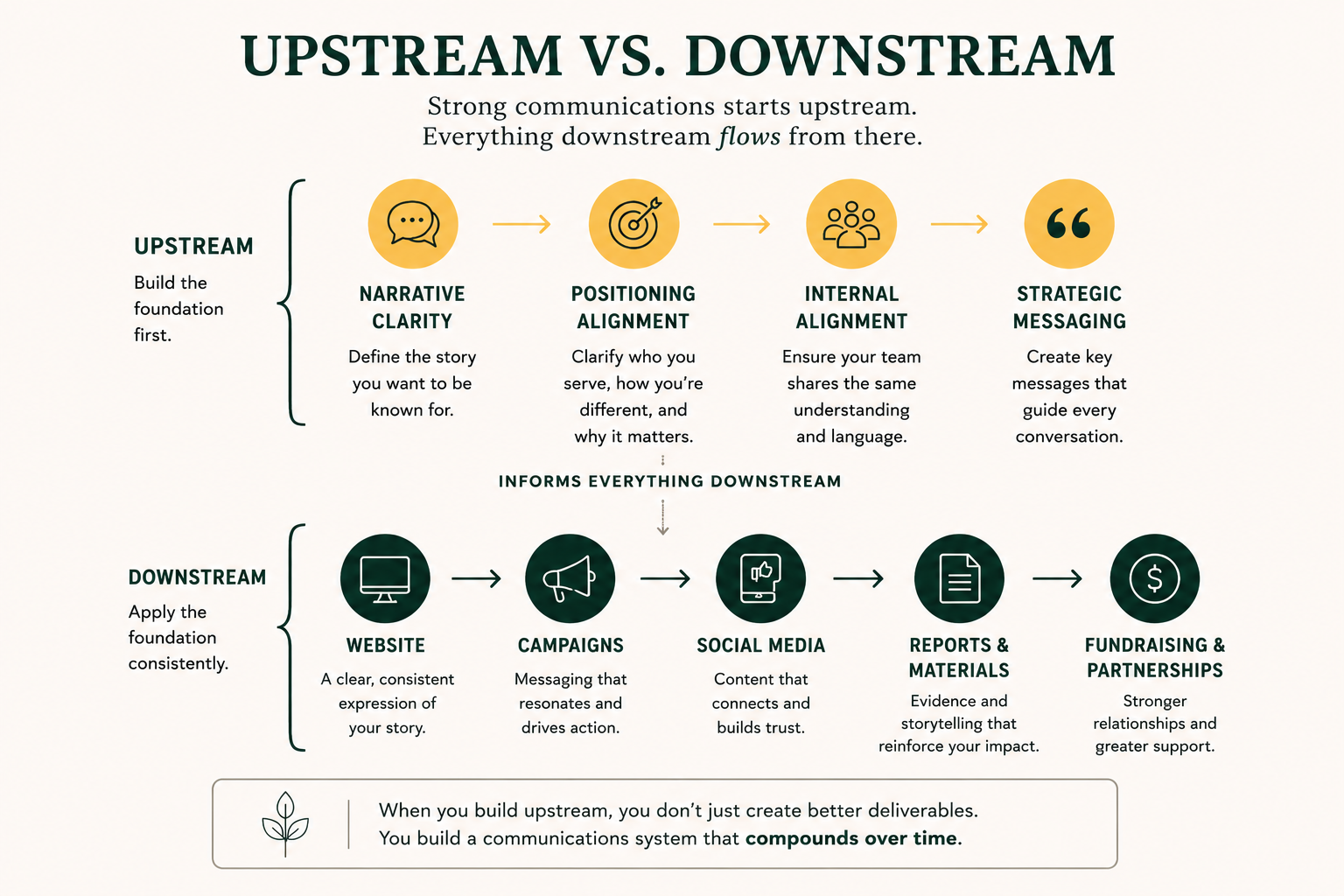
When I talk about narrative clarity, I do not mean a tagline or a polished about-us page. Those are downstream artifacts that get produced once the foundation is in place. The foundation itself is a strategic document: the kind of work that articulates what the organization actually stands for, who it is talking to, and why it matters, in language the whole team can use. That document is what trains internal alignment, and everything downstream, the website, the campaigns, the funder conversations, the brand voice work, flows from there.
Once that internal alignment exists, the tactical layer becomes much easier. The website rewrite that used to take six months takes six weeks because there is something to write toward. The social strategy stops being a guessing game about which posts will resonate, because the message is consistent regardless of format. The impact report becomes a synthesis of an existing story rather than an annual attempt to invent one.
This is what I mean when I say narrative clarity is infrastructure. Once it is built, every downstream decision becomes faster, cheaper, and more aligned. Future deliverables stop being one-off problems and start being applications of an existing foundation.
The conversation that comes next
The hardest conversations I have with clients usually go something like this: "I can absolutely build you the thing you asked for, but I think you need something else first." Some teams are not ready to hear that. They have a board pushing for a new website, a campaign already scheduled, a fiscal year that ends in three months. The tactical ask feels urgent, and the upstream work feels like a delay.
The teams who are ready to hear it tend to share a few things in common. They have noticed the inconsistency themselves, even if they have not named it. They have had at least one funder meeting that left them wondering why the conversation felt off. They have a leader, usually the ED or a senior comms person, who is willing to slow down for two weeks of foundational work in order to save six months of tactical work later.
The orgs who do that work tend to stay with us for years, because once the foundation is in place, the rest of the work compounds. The ones who do not, often come back twelve to eighteen months later with the same problem in a different form. The website launched, but the funder conversations still are not converting. The campaign ran, but the team is still describing the work in five different ways.
If your team is staring down a tactical communications project right now and wondering whether you have the foundation to do it well, that is the question worth sitting with first. The deliverable can wait two weeks, but the narrative cannot.
Stay connected
If you want to talk through whether your organization has the narrative foundation for the work you are about to start, I would love to connect.
Book a call here or email me at nina@sunflower-communications.com