“Community building in the impact sector is treated as external work, done with funders, partners, clients, and donors. The same intention applied inside the organization is internal community building, a communications discipline: whether the whole team shares the narrative, carries it in consistent language, and helps shape the decisions behind it. External trust rests on that internal foundation.”
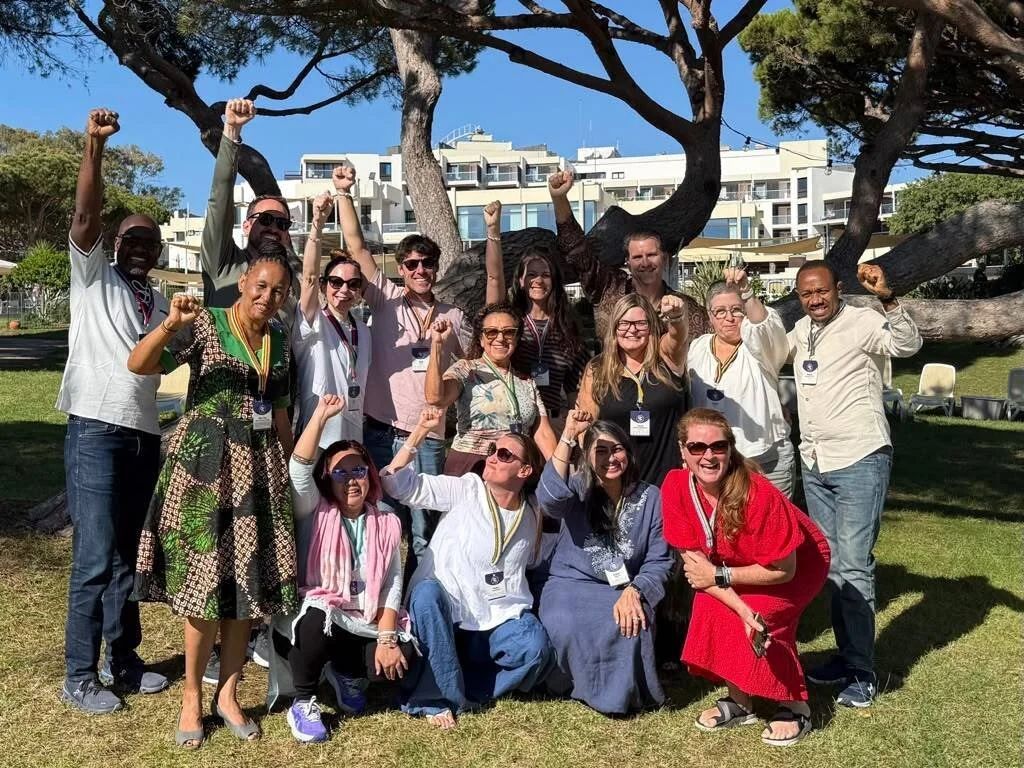
My Leadership group at the OC conference
Earlier this month I was in Albufeira, Portugal for Opportunity Collaboration, an “unconference” built on the premise that the most valuable thing that can happen between impact leaders is a real relationship, so the whole event is designed to build those relationships rather than leave them up to each individual and good timing. Instead of keynotes and a stage, every participant is placed in a leadership circle of ten to fifteen people that meets each morning of the conference, which means the conversation deepens each time, and by the end you know those people in a way that traditional networking never gets you to.
Community building was a big theme of the week, in the circles, the sessions, and the conversations. In our sector, we almost always mean something external by the phrase, the work of building relationships with the people outside the organization who make the mission possible: partners, donors, clients, funders, collaborators. But it made me think about how the same concept needs to be applied internally too.
Community building has an inside

OC 2026 - Albufeira, Portugal
One of the conversations in my leadership circle turned to what happens to a team under strain, the stretch of high turnover, or a period where everything is stressful and nobody has any slack. That is exactly when internal communications stops being a background function and becomes the thing holding the team together, because a team under pressure that is not aligned on what the organization is doing and why begins to fracture in small ways that show up everywhere else.
Internal community building is both a communications discipline and a culture one. It is whether the whole team shares the same answer to what the organization does and where it is going, whether people carry that answer in the same language, and whether they had a hand in shaping the decisions underneath it rather than receiving them after the fact.
What alignment actually asks of a team
That last part is where most internal alignment is won or lost. When decisions are made at the top and handed down as finished, the team can repeat them but cannot stand behind them, because they had no part in forming them. When the people doing the work, including the most junior person on the team, are brought into the decisions that shape the organization's direction, or at least into the conversations around them, they own the message in a way no internal memo produces.
It is a smaller-scale version of a shift the sector already believes in on the funding side, where trust-based philanthropy argues that organizations should tell funders what they need rather than funders setting the terms from a distance. The same logic holds inside the walls of an organization. The people closest to the work carry information the top of the organization does not, and a decision shaped with them is sturdier than one announced to them.
This is not an argument that every decision becomes a vote or that a team runs on consensus. Someone still carries responsibility for the call, and leaders who blur that in the name of inclusion tend to create more confusion, not less. The distinction is between a voice in the conversation and a say over the outcome. People own a message because they were there when it was shaped, not because they got to approve it.
You can see the difference in onboarding. In an aligned organization a new hire can describe the work accurately within a few weeks, because the story is consistent everywhere they look, and in a misaligned one they spend months guessing which version of it is the real one.
Why the inside shows up on the outside

I hosted a Strategic Positioning Q&A at OC
When a team is aligned this way, the first thing it produces is consistency. Everyone describes the organization in the same terms, the website and the newsletter and the way a program lead talks about the work at an event all point to the same place, and that consistency is what builds trust with the people outside the organization. External community, the kind OC is built to create, rests on it. A funder, a partner, or a prospective collaborator who hears a clear and consistent account of what you do and why will trust it, and that trust is what eventually becomes funding and support, which is what lets the work on the ground continue.
The cost of skipping it is specific. A team that is not internally aligned sends mixed signals outward: the program officer hears one version of the mission from the ED and another from the website, the donor cannot tell what has changed since last year, and staff spend time reconciling versions of the story that are outdated. Misalignment inside the organization is a leak, and what leaks out is the trust and the time that were meant to go to the mission.
The message beyond the leader
Deciding who the organization is and what it stands for is leadership's work (read How Comms & Leadership Are More Connected Than You Think). But the decision is only a part of it. Once a leader has made the call, the work that remains is making it live across the whole team, so the narrative is not something the founder carries alone but something everyone can hold and say in their own words. That is the internal version of what OC does so well with its circles, building the relationships and the shared understanding on purpose rather than hoping they form on their own.
The organizations whose external community holds are often the ones that built an internal community first, where the team knew the story and believed it before anyone outside was even brought in.
Stay connected
Internal and external communications are the same system, and the state of one shapes the other. The Impact Comms Diagnostic reads where yours stands, inside and out, in twelve questions. Take the Impact Comms Diagnostic here.
FAQ
What is internal community building for a mission-driven organization?
It is the work of building a shared understanding across your own team, so everyone knows what the organization does, where it is going, and how to say it in consistent language. It is the inward version of the relationship building most organizations only do with funders and partners, and it is a communications function more than an HR one.
How is internal communications different from company culture?
Culture is the broader climate of how people work together. Internal communications is the narrower, more concrete question of whether the team shares one clear account of the mission and the decisions behind it. You can have a warm culture and still have a team that describes the organization five different ways, which is a communications problem, not a culture one.
What is the first thing a leader should do to align a team on messaging?
Bring the team into the decisions that shape the organization's direction before those decisions are final, not after. People carry a message consistently when they helped shape it, so the alignment starts in the conversation, long before anyone writes a key-messaging document.
Why does internal alignment affect funding and external relationships?
Funders, partners, and donors trust an organization that gives them a clear and consistent account of its work, and that consistency can only come from a team that already shares it internally. When the inside is misaligned, the outside hears mixed signals, and trust erodes before a relationship can build.
How long does it take to get a team aligned on a shared narrative? I
t depends on the size of the team and how settled the underlying narrative already is, but the first move is deciding the narrative clearly at the leadership level, then building it into how the team works day to day. It is ongoing work rather than a one-time exercise, reinforced every time a new decision or a new hire enters the picture.